ORIGINAL ARTICLE
Temporal Trends and Epidemiological Profile of Non-Melanoma Skin Cancer in a High-Complexity Oncology Center in Rio Grande do Norte, Brazil
Tendências Temporais e Perfil Epidemiológico do Câncer de Pele não Melanoma em um Centro Oncológico de Alta Complexidade no Rio Grande do Norte, Brasil
Tendencias Temporales y Perfil Epidemiológico del Cáncer de Piel no Melanoma en un Centro Oncológico de Alta Complejidad en Río Grande del Norte, Brasil
https://doi.org/10.32635/2176-9745.RBC.2026v72n2.5299
Pedro Hortêncio Saboia da Escossia Melo1; Tiago Rodrigues da Fonseca2; Gabriella Ferezini Oliveira de Sá3; Pedro Vilar de Oliveira Villarim4; Ayane Cristine Alves Sarmento5; Kleyton Santos de Medeiros6; Cristina Rocha de Medeiros Miranda7; Edilmar de Moura Santos8
1-4Universidade Federal do Rio Grande do Norte (UFRN), Departamento de Medicina. Natal (RN), Brasil. E-mails: pedroescossia@gmail.com; tiagorodrigues812@gmail.com; gabriellaferezini@hotmail.com; pedrovillarim123@gmail.com. Orcid iD: https://orcid.org/0009-0009-2771-4242; Orcid iD: https://orcid.org/0009-0001-8471-3838; Orcid iD: https://orcid.org/0009-0006-0972-0372; Orcid iD: https://orcid.org/0000-0002-9504-8589
5,6Liga Contra o Câncer, Instituto de Ensino, Pesquisa e Inovação. Natal (RN), Brasil. UFRN, Programa de Pós-Graduação em Ciências da Saúde. Natal (RN), Brasil. E-mails: ayane.sarmento@hotmail.com; kleyton_medeiros@hotmail.com. Orcid iD: https://orcid.org/0000-0001-9131-1952; Orcid iD: https://orcid.org/0000-0002-4105-7535
7UFRN, Departamento de Cirurgia. Natal (RN) Brasil. E-mail: cristina.rocha@liga.org.br. Orcid iD: https://orcid.org/0000-0001-9301-7917
8Liga Contra o Câncer, Departamento de Radioterapia Oncológica. Natal (RN) Brasil. E-mail: edilmar.moura@liga.org.br. Orcid iD: https://orcid.org/0000-0001-5814-8997
Corresponding author: Ayane Cristine Alves Sarmento. Rua Senador Agenor Maria, 76 –
Parque das Nações. Parnamirim (RN), Brasil. CEP 59158-210. E-mail: ayane_cris@hotmail.com
ABSTRACT
Introduction: Non-melanoma skin cancer (NMSC) is the most common malignancy worldwide. Objective: To describe the temporal trend and epidemiological profile of patients diagnosed with NMSC at a high-complexity oncology center in Rio Grande do Norte, Brazil. Method: Retrospective descriptive study using hospital-based cancer registry data. Data was collected from all patients diagnosed with NMSC classified as C44 of the ICD-10 in the study site from 2011 to 2018. The variables included sex, age, ethnicity, education level, histopathology, and treatment. Annual case counts and their 95% confidence intervals were computed solely for descriptive purposes, and categorical variables were expressed as frequencies and percentages. Results: A total of 18,844 NMSC cases were diagnosed. The most affected were individuals in their seventh decade of life, accounting for 4,888 cases (25.9%), while the least affected group was those aged 0-19 years, with only 19 cases (0.1%). Most cases occurred in patients with no formal education or incomplete elementary education (56.16%). The most affected anatomical site was head and neck, including lip, eyelid, external ear, face, scalp, and neck with 70.95% of the cases. Basal cell carcinoma was the most common histological type, representing 72.9% of the diagnoses. Additionally, 98.25% of the patients underwent surgical procedures, either as a sole treatment or in combination with other therapies. Conclusion: The increasing number of NMSC diagnoses recorded in the institution over the years highlights the urgency of continuous surveillance and effective preventive strategies, particularly in regions with significant socioeconomic and environmental risk factors as Rio Grande do Norte.
Key words: Non-Melanoma Skin Neoplasms; Health Profile; Basal Cell Carcinoma; Carcinoma, Squamous Cell.
RESUMO
Introdução: O câncer de pele não melanoma (CPNM) é a neoplasia maligna mais comum no mundo e tem apresentado incidência crescente nas últimas décadas. Objetivo: Descrever a tendência temporal e o perfil epidemiológico de pacientes diagnosticados com CPNM em um centro oncológico de alta complexidade no Rio Grande do Norte, Brasil. Método: Estudo descritivo retrospectivo que utiliza dados de registros de câncer hospitalares. Os dados foram coletados de todos os pacientes diagnosticados com CPNM classificados sob o código C44 da CID-10 no período de 2011 a 2018. As variáveis analisadas incluíram sexo, idade, etnia, escolaridade, histopatologia e tratamento. Os números anuais de casos e seus intervalos de confiança de 95% foram calculados para fins descritivos, e as variáveis categóricas foram expressas em frequências e porcentagens. Resultados: Foram diagnosticados 18.844 casos de CPNM. A faixa etária mais afetada foi a de indivíduos na sétima década de vida, com 4.888 casos (25,9%), enquanto o grupo menos afetado foi o de 0 a 19 anos, com apenas 19 casos (0,1%). A maioria dos casos ocorreu em pacientes sem escolaridade ou com ensino fundamental incompleto (56,16%). A região anatômica mais acometida foi cabeça e pescoço, incluindo lábio, pálpebra, orelha externa, face, couro cabeludo e pescoço, compreendendo 70,95% dos casos. O carcinoma basocelular foi o tipo histológico mais comum, representando 72,9% dos diagnósticos. Além disso, 98,25% dos pacientes foram submetidos a procedimentos cirúrgicos, como tratamento único ou combinado com outras terapias. Conclusão: O crescente número de diagnósticos de CPNM registrados na instituição ao longo dos anos destaca a necessidade urgente de vigilância contínua e estratégias preventivas eficazes, particularmente em Regiões com significativos fatores de risco socioeconômicos e ambientais, como o Rio Grande do Norte.
Palavras-chave: Neoplasias Cutâneas não Melanoma; Perfil de Saúde; Carcinoma Basocelular; Carcinoma de Células Escamosas.
RESUMEN
Introducción: El cáncer de piel no
melanoma (CPNM) es la neoplasia maligna más común a nivel mundial y su
incidencia ha aumentado en las últimas décadas. Objetivo: Describir la tendencia
temporal y el perfil epidemiológico de los pacientes diagnosticados con CPNM en
un centro oncológico de alta complejidad en Rio Grande do Norte, Brasil. Método:
Estudio descriptivo retrospectivo que utiliza datos de registros de cáncer de
centros hospitalarios. Se recopilaron datos de todos los pacientes
diagnosticados con CPNM clasificados bajo el código C44 de la CIE-10 entre 2011
y 2018. Las variables analizadas incluyeron sexo, edad, etnia, nivel educativo,
histopatología y tratamiento. Los recuentos anuales de casos y sus intervalos
de confianza del 95% se calcularon únicamente con fines descriptivos, y las
variables categóricas se expresaron como frecuencias y porcentajes. Resultados:
Se diagnosticaron un total de 18 844 casos de CPNM. El
grupo etario más afectado fue el de personas en la séptima década de vida, con
4888 casos (25,9%), mientras que el grupo menos afectado fue el de 0 a 19 años,
con solo 19 casos (0,1%). La mayoría de los casos ocurrió en pacientes sin estudios
o con educación primaria incompleta (56,16%). La región anatómica más afectada
fue la cabeza y el cuello, incluyendo labios, párpados, oído externo, rostro,
cuero cabelludo y cuello, representando el 70,95% de los casos. El carcinoma
basocelular fue el tipo histológico más común, representando el 72,9% de los
diagnósticos. Además, el 98,25% de los pacientes se sometió a procedimientos
quirúrgicos, ya sea como tratamiento único o combinado con otras terapias. Conclusión:
El creciente número de diagnósticos de CPNM registrados en la institución a lo
largo de los años resalta la urgente necesidad de una vigilancia continua y de
estrategias preventivas eficaces, particularmente en regiones con importantes
factores de riesgo socioeconómicos y ambientales, como Río Grande del Norte.
Palabras clave: Neoplasias de Piel no Melanoma; Perfil de Salud; Carcinoma Basocelular; Carcinoma de Células Escamosas.
INTRODUCTION
Skin cancer is the most common malignancy worldwide. In the United States, the American Cancer Society estimated that in 2025, about 99,780 new cases of melanoma and about 3.6 million cases of Non-Melanoma Skin Cancer (NMSC) would be diagnosed1,2. In Brazil, the estimated number of new cases of NMSC for the triennium 2026-2028 was 518,000. Rio Grande do Norte, a Northeast Brazilian state, is a region at potential risk for the development of this disease due to several predisposing factors3.
Although largely preventable, the incidence of skin cancer has been increasing over the years, posing a growing threat to global health4-5. Socioeconomic factors, as low educational, lack of access to consistent preventive care and occupational exposure, can influence individuals’ ability to adopt preventive strategies. Uncertainty and inaccurate perceptions are particularly common among older adults, ethnic minorities, and those with limited education6.
Furthermore, there is strong evidence linking skin cancer to sun exposure as photo-exposed areas are the most affected anatomical sites. The risk of skin cancer increases with the intensity of radiation exposure. However, due to the relatively low lethality rates associated with NMSC, this condition has often been neglected as reflected in its absence from many cancer statistics7.
Since the primary risk factors for NMSC are linked to environmental and socioeconomic factors, it is crucial to identify the most vulnerable country regions. This will facilitate the development of targeted prevention and surveillance strategies for these populations8-10.
METHOD
This retrospective descriptive study was conducted using hospital-based cancer registry data and is reported in accordance with the Strengthening the Reporting of Observational Studies in Epidemiology (STROBE)11 guidelines.
The study was performed at the “Liga Norte Riograndense Contra o Câncer”, the sole high-complexity oncology center in Rio Grande do Norte, Brazil. All the patients diagnosed with non-melanoma skin cancer classified according to ICD-10:C44 (International Classification of Diseases)12 and recorded in the Hospital Cancer Registry (RHC) of the institution between 2011 and 2018 have been analyzed.
To characterize the population investigated, gender, age group, ethnicity, education level, primary location, histopathology and treatment information were utilized.
Ethnicity and educational level were self-reported at the institution and are therefore subject to individual subjectivity and recall bias. The group self-identified as “parda” was described as “Brown-skin”.
Data on all NMSC diagnoses were extracted from the institution’s RHC, using the ICD-10 code C44 (other malignant neoplasms of the skin). Missing information was recorded as “No Information”, reflecting the absence of these data in some medical records. Annual case counts and their 95% confidence intervals were computed solely for descriptive purposes, and categorical variables were expressed as frequencies and percentages.
To compare the proportions of diagnoses among groups, the chi-square test of adherence was employed, with the alternative hypothesis being that these proportions differ among the categories. The Mann-Kendall test was applied to assess the existence of trends, whether increasing or decreasing in diagnoses within each group over the years.
In all cases, a significance level of α = 5% was considered, and the hypothesis was rejected in cases of p > 0.05. The Mann-Kendall test was used to assess monotonic trends over time. The S statistic represents the direction and magnitude of the trend, with positive values indicating an increasing trend and negative values indicating a decreasing trend. Data analysis was performed using the R software13 (R Foundation for Statistical Computing, Vienna, Austria), version 4.5.1.
Due to the low representation of Asian and Indigenous groups in the study population, these categories were aggregated into ‘Other’ classification to avoid empty cells and ensure more robust statistical analyses.
The Ethics Committee of the institution approved the study, report 5561998 (CAAE (submission for ethical review): 60783222.3.0000.5293). The informed consent form was waived because only secondary, deidentified data were utilized in compliance with Directive 466/201214 of the National Health Council (CNS).
RESULTS
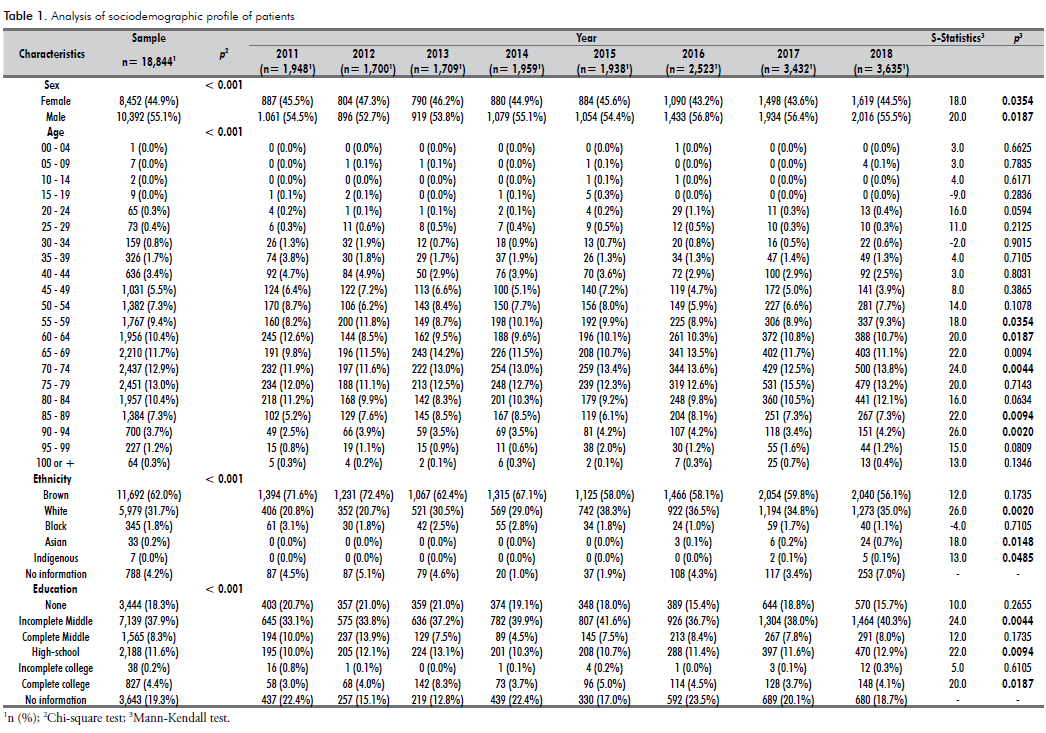
During the study period (2011–2018), a total of 18,844 NMSC diagnoses were recorded at the institution, the hospital’s annual caseload of patients treated for NMSC, with a median of 1,953.5 diagnoses per year (range: 1,700–3,635). There was a higher concentration of cases detected in male patients (55.1%). The septuagenarians were the most affected in both sexes, comprising 4,888 patients (25.9% of the cases), while the least affected was the 0-19 age group, with only 19 cases (0.1%). Among all groups, a statistically significant rising trend was found for the annual frequencies of fair-skin (S = 26.0; p = 0.0020), Asian (S = 18.0; p = 0.0148), and Indigenous (S = 13.0; p = 0.0485) patients. There was a higher concentration of cases in patients with no education or incomplete elementary education, accounting for 56.16% of the cases (p <0.001) (Table 1).
Head and neck (lip skin, eyelid, external ear, skin of other parts of the face, scalp skin, and neck) stood out among the most affected topographical areas, accounting for 70.95% of the cases, followed by the skin of the shoulder and upper limbs (ICD 44.6, 12.9%) and the trunk skin (ICD 44.5, 12.8%) (Figure 1). The detailed annual analysis can be seen in Table 2.
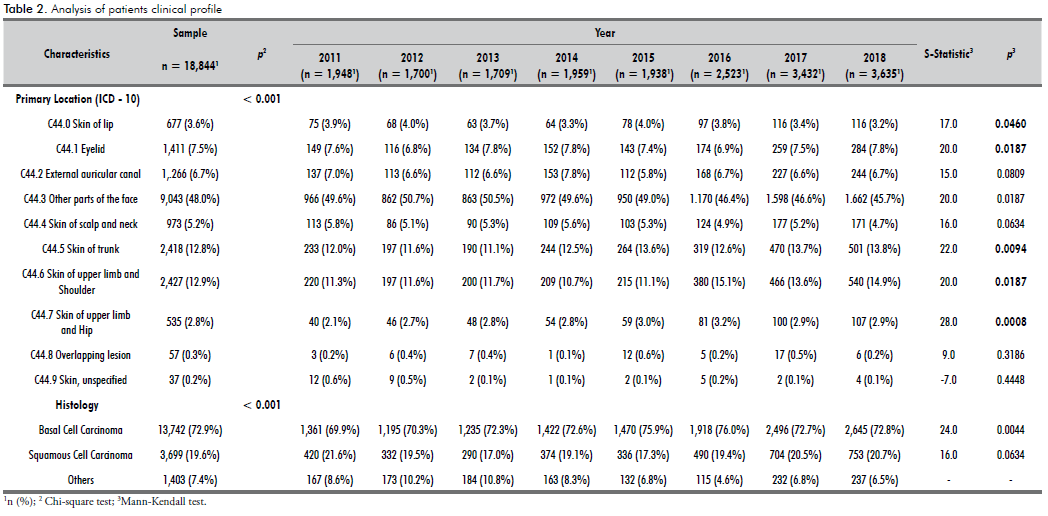
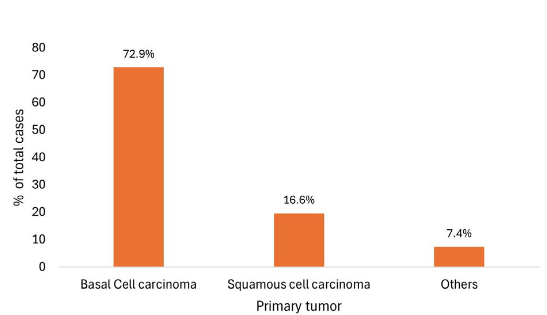
Figure 1. Distribution of cases according to primary tumor
The most frequent pathological diagnosis was basal cell carcinoma (72.9%), with a significant increase in the number of cases over time (S = 24.0; p = 0.0044), followed by squamous cell carcinoma (19.6%) (Figure 2).
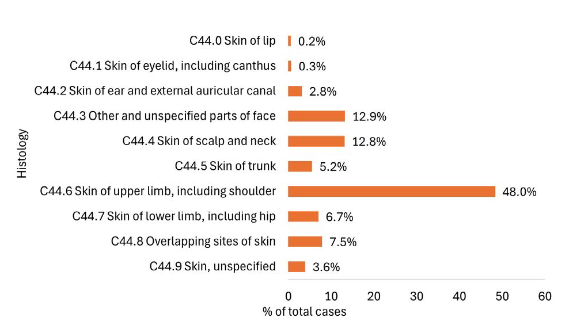
Figure 2. Distribution of cases according to histology
During the study period, 98.25% of the patients underwent surgical procedures, either as exclusive treatment or in combination with other treatments. A statistically significant increase in the number of surgical procedures performed during the period under analysis was found (p < 0.0001), as well as the presence of a significant increasing trend (S = 22.0; p = 0.0094). The percentage of patients undergoing chemotherapy over the years showed statistically significant variation (p = 0.0357); however, this difference did not result in a statistically significant temporal trend (S = -5.0; p = 0.6180). The detailed annual analysis is presented in Table 3.

DISCUSSION
The results revealed a high number of NMSC diagnoses recorded at the institution over the years, with an increasing trend throughout the study period. As a tertiary referral oncology center and the only high-complexity cancer service in the state, the caseload reflects both spontaneous demand and referrals from multiple municipalities15.
Although hospital-based figures cannot be interpreted as incidence, the magnitude of the caseload underscores the high demand for dermatologic oncology care in the region.
While there has been a trend of increasing diagnoses in both sexes, a higher concentration of cases is observed among males due to increased occupational sun exposure more prevalent in this population, as construction and agriculture, supported by the literature15-18. Additionally, women tend to seek healthcare and engage in self-care more frequently, which may contribute to earlier detection.
The population of Rio Grande do Norte is predominantly composed of two ethnic groups: White (39.5%) and Brown (50.9%)10. However, the higher prevalence (62%) of Brown patients found in this study, compared to 31.4% of White patients, suggests a higher prevalence of the disease for that population. This observation can be attributed to the socioeconomic and cultural differences present in the ethnic distribution of the population, highlighting the importance of primary prevention even for individuals with more melanized skin19.
The present findings are consistent with previous reports demonstrating the predominance of NMSC in chronically sun-exposed areas, particularly the head and neck, and among older individuals, especially in the seventh decade of life18,20. This pattern is biologically plausible given cumulative ultraviolet exposure and age-related skin changes1,8,20.
The higher prevalence of NMSC among individuals with no education or incomplete elementary education (often associated with a more unstable socioeconomic situation) points to greater difficulties in seeking early care and treatment, possibly due to lack of information and awareness about the disease17. Additionally, this group tends to have longer periods of occupational sun exposure and scarce resources to purchase sunscreens and other protective measures21.
While surgical treatment is established worldwide, and widely available in many countries22, a rising trend of surgical procedures was observed over the years, which likely indicates a shift toward more active patient treatment and broader coverage of healthcare locally. These statistics are encouraging as they represent a potential advancement in healthcare services and the impact of established public health campaigns.
Moreover, the observed increase in NMSC diagnoses highlights the need for ongoing surveillance and preventive measures, especially in regions with socioeconomic and environmental risk factors as Rio Grande do Norte. Educational campaigns focused on sun protection, regular skin examinations, and early detection strategies could play crucial roles in public health strategies to control NMSC23.
CONCLUSION
The increasing number of NMSC diagnoses recorded in the institution over the years highlights the urgent need for continuous surveillance and effective preventive strategies, particularly in regions with significant socioeconomic and environmental risk factors as Rio Grande do Norte. Identifying high-risk groups, especially older men with low educational levels, enables healthcare providers and policymakers to optimize resource allocation and implement targeted interventions aimed at reducing disease burden and enhancing NMSC management.
CONTRIBUTIONS
Pedro Hortêncio Saboia da Escossia Melo contributed to the study conception and design, data curation and writing of the manuscript. Tiago Rodrigues da Fonseca and Gabriella Ferezini Oliveira de Sá contributed to data curation, analysis, critical review and writing of the manuscript. Pedro Vilar de Oliveira Villarim contributed to the methodology, validation and writing of the manuscript. Ayane Cristine Alves Sarmento contributed to the supervision, methodology and writing of the manuscript. Kleyton Santos de Medeiros contributed to the study conception, supervision, validation and writing of the manuscript. Cristina Rocha de Medeiros Miranda contributed to the study conception, validation and writing of the manuscript. Edilmar de Moura Santos contributed to the study conception and supervision. All the authors approved the final version for publication.
DECLARATION OF CONFLICT OF INTERESTS
There is no conflict of interest to declare.
DATA AVAILABILITY STATEMENT
All content underlying the text is contained in the manuscript.
FUNDING SOURCES
None.
REFERENCES
1. American Cancer Society. Cancer facts & figures 2025 [Internet]. Atlanta: American Cancer Society; 2025 [cited 2025 May 12]. Available from: https://www.cancer.org
2. Ciążyńska M, Kamińska-Winciorek G, Lange D, et al. The incidence and clinical analysis of non-melanoma skin cancer. Sci Rep. 2021;11(1):4337. doi: https://doi.org/10.1038/s41598-021-83502-8
3. Martins LFL, Chaves GV, Oliveira JFP, et al. Perfil epidemiológico da incidência de câncer no Brasil e regiões: estimativas para o triênio 2026-2028. Rev Bras Cancerol. 2026;72(2):e-025587. doi: https://doi.org/10.32635/2176-9745.RBC.2026v72n2.5587
4. Gordon R. Skin cancer: an overview of epidemiology and risk factors. Semin Oncol Nurs. 2013;29(3):160-9. doi: https://doi.org/10.1016/j.soncn.2013.06.002
5. Rogers HW, Weinstock MA, Feldman SR, et al. Incidence estimate of nonmelanoma skin cancer (keratinocyte carcinomas) in the U.S. population, 2012. JAMA Dermatol. 2015;151(10):1081-6. doi: https://doi.org/10.1001/jamadermatol.2015.1187
6. Merrill SJ, Ashrafi S, Subramanian M, et al. Exponentially increasing incidences of cutaneous malignant melanoma in Europe correlate with low personal annual UV doses and suggest two major risk factors. Dermatoendocrinol. 2015;7(1):e1004018. doi: https://doi.org/10.1080/19381980.2014.1004018
7. Silva E, Tavares R, Paulitsch F, et al. Use of sunscreen and risk of melanoma and non-melanoma skin cancer: a systematic review and meta-analysis. Eur J Dermatol. 2018;28(2):186-201. doi: https://doi.org/10.1684/ejd.2018.3251
8. Lomas A, Leonardi-Bee J, Bath-Hextall F. A systematic review of worldwide incidence of nonmelanoma skin cancer. Br J Dermatol. 2012;166(5):1069-80. doi: https://doi.org/10.1111/j.1365-2133.2012.10830.x
9. Buster KJ, You Z, Fouad M, et al. Skin cancer risk perceptions: a comparison across ethnicity, age, education, gender, and income. J Am Acad Dermatol. 2012;66(5):771-9. doi: https://doi.org/10.1016/j.jaad.2011.05.021
10. Armstrong BK, Kricker A. The epidemiology of UV-induced skin cancer. J Photochem Photobiol B. 2001;63(1-3):8-18. doi: https://doi.org/10.1016/s1011-1344(01)00198-1
11. University of Bern. STROBE: Strengthening the Reporting of Observational Studies in Epidemiology [Internet]. Mittelstrasse: Institute of Social and Preventive Medicine; 2024©. [cited 2024 Feb 19]. Available from: https://www.strobe-statement.org/
12. Organização Mundial da Saúde. CID-10: Classificação Estatística Internacional de Doenças e problemas relacionados à saúde. São Paulo: Edusp; 2008.
13. R Core Team : a language and environment for statistical computing [Internet]. Version 4.5.1. Vienna: R Foundation for Statistical Computing; 2025 [acesso 2025 abr 25]. Available from: https://www.R-project.org/
14. Conselho Nacional de Saúde (BR). Resolução nº 466 de 12 de dezembro de 2012. Aprova diretrizes e normas regulamentadoras de pesquisas envolvendo seres humanos. Diário Oficial da União, Brasília, DF. 2013 jun 13; Edição 112; Seção 1:59.
15. Global Burden of Disease Cancer Collaboration, Fitzmaurice C, Abate D, et al. Global, regional, and national cancer incidence, mortality, years of life lost, years lived with disability, and disability-adjusted life-years for 29 cancer groups, 1990 to 2017: a systematic analysis for the Global Burden of Disease Study. JAMA Oncol. 2019;5(12):1749-68. doi: https://doi.org/10.1001/jamaoncol.2019.2996. Erratum in: JAMA Oncol. 2020;6(3):444. doi: https://doi.org/10.1001/jamaoncol.2020.0224
16. Xu Q, Wang X, Bai Y, et al. Trends of non-melanoma skin cancer incidence in Hong Kong and projection up to 2030 based on changing demographics. Ann Med. 2023;55(1):146-54. doi: https://doi.org/10.1080/07853890.2022.2154382
17. Cayuela L, Pereyra-Rodríguez JJ, Hernández-Rodríguez JC, et al. Non-melanoma skin cancer burden in Spain: a nationwide analysis of incidence trends (1990-2019). Eur J Dermatol. 2024;34(4):392-7. doi: https://doi.org/10.1080/07853890.2022.2154382
18. Aggarwal P, Knabel P, Fleischer Junior AB . United States burden of melanoma and non-melanoma skin cancer from 1990 to 2019. J Am Acad Dermatol. 2021;85(2):388-95. doi: https://doi.org/10.1016/j.jaad.2021.03.109
19. Fekri M, Dehesh P, Tahmasbi Arashlow F. et al. Epidemiology and socioeconomic factors of nonmelanoma skin cancer in the Middle East and North Africa 1990 to 2021. Sci Rep. 2025;15(17904). doi: https://doi.org/10.1038/s41598-025-99434-6
20. Ciuciulete AR, Stepan AE, Andreiana BC, et al. Non-melanoma skin cancer: statistical associations between clinical parameters. Curr Health Sci J. 2022;48(1):110-5. doi: https://doi.org/10.12865/chsj.48.01.16
21. Ginsburg O, Vanderpuye V, Beddoe AM, et al. Women, power, and cancer: a Lancet Commission. Lancet. 2023;402(10417):2113-66. doi: https://doi.org/10.1016/s0140-6736(23)01701-4
22. Lv R, Sun Q. A network meta-analysis of non-melanoma skin cancer (NMSC) treatments: efficacy and safety assessment. J Cell Biochem. 2017;118(11):3686-95. doi: https://doi.org/10.1002/jcb.26015
23. Sánchez G, Nova J, Rodriguez-Hernandez AE, et al. Sun protection for preventing basal cell and squamous cell skin cancers. Cochrane Database Syst Rev. 2016;7(7):CD011161. doi: https://doi.org/10.1002/14651858.cd011161.pub2
Recebido em 13/6/2025
Aprovado em 29/12/2025
Associate editor: Jeane Tomazelli. Orcid iD: https://orcid.org/0000-0002-2472-3444
Scientific-editor: Anke Bergmann. Orcid iD: https://orcid.org/0000-0002-1972-8777

Este é um artigo publicado em acesso aberto (Open Access) sob a licença Creative Commons Attribution, que permite uso, distribuição e reprodução em qualquer meio, sem restrições, desde que o trabalho original seja corretamente citado.